

Dwarf Korean Lilac (tree form)
Syringa meyeri 'Palibin (tree form)'

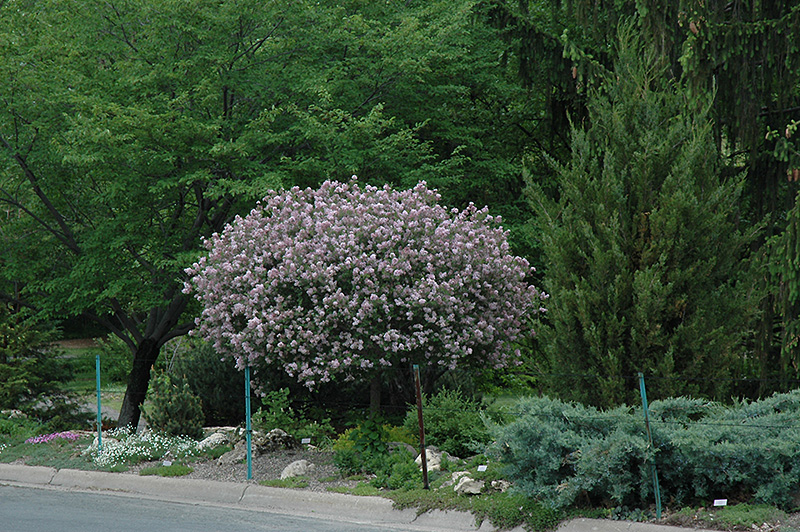
Height: 7 feet
Spread: 4 feet
Sunlight:

Hardiness Zone: 3
Description:
A beautiful and popular patio shrub with numerous attributes; striking spikes of fragrant lilac-pink flowers in late spring, small rounded foliage and a uniform compact ball shape grafted onto a standard, best used as a solitary accent in the garden
Ornamental Features
Dwarf Korean Lilac (tree form) is smothered in stunning panicles of fragrant lilac purple flowers at the ends of the branches in late spring, which emerge from distinctive violet flower buds. The flowers are excellent for cutting. It has dark green deciduous foliage which emerges burgundy in spring. The small pointy leaves do not develop any appreciable fall color.
Landscape Attributes
Dwarf Korean Lilac (tree form) is a dense deciduous tree, selected and trained to grow in a small tree-like form with the primary plant grafted high atop a standard. Its relatively fine texture sets it apart from other landscape plants with less refined foliage.
This is a relatively low maintenance tree, and should only be pruned after flowering to avoid removing any of the current season's flowers. It is a good choice for attracting butterflies to your yard. It has no significant negative characteristics.
Dwarf Korean Lilac (tree form) is recommended for the following landscape applications;
- Accent
- General Garden Use
Planting & Growing
Dwarf Korean Lilac (tree form) will grow to be about 7 feet tall at maturity, with a spread of 4 feet. It tends to be a little leggy, with a typical clearance of 3 feet from the ground, and is suitable for planting under power lines. It grows at a slow rate, and under ideal conditions can be expected to live for approximately 30 years.
This tree should only be grown in full sunlight. It is very adaptable to both dry and moist locations, and should do just fine under average home landscape conditions. It is not particular as to soil type or pH. It is highly tolerant of urban pollution and will even thrive in inner city environments. This is a selected variety of a species not originally from North America.






Disclaimer - This Plant Finder tool is an online resource representing many of the varieties that we carry over the course of the season, and is intended for informational purposes only. Inventory varies seasonally, so we cannot guarantee that every plant will be in stock at all times - please contact the store directly for current availability. It does not include our entire selection of plants, so be sure to visit our store to see varieties that may not be represented on this list.